

Sloped Floors
-
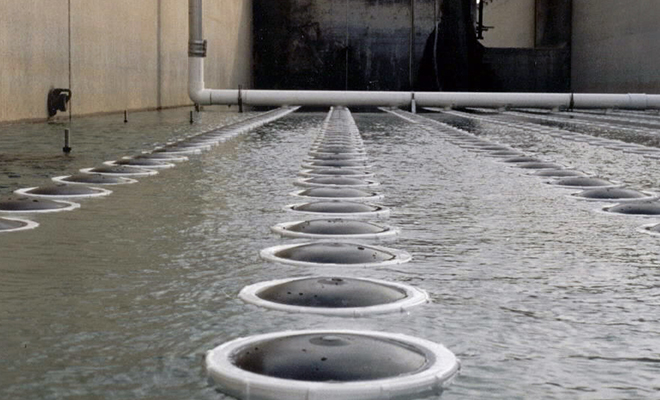
Accounting for sloped floor in aeration tanks.
In an aeration system, all diffusers on a common air main are required to have the same static submergence and therefore must be level.
Do the diffusers need to be level?
When designing an aeration grid, questions regarding how aeration manufacturers handle sloped floors frequently arise. Are the diffusers installed parallel with the slope? Do they need to be level? How much of a slope is allowed?
In an aeration system all diffusers on a common air main are required to have the same static submergence More specifically, all of the diffusers within the same air grid must be level to within ± ¼” of the elevation listed on the drawings. If any of the diffusers are not level, the air will take the path of least resistance and exit out of the diffusers that have the least amount of static submergence first. Uneven distribution results in:
• A negative effect on the grid’s oxygen transfer efficiency
• Increased back pressure on the blowers
• Decreased ability of the system to mix the tank – potentially leading to solids deposition
• Premature fouling and aging of the diffusers
Having diffusers in tanks of differing water levels or with different static submergences is not recommended except under very unique circumstances for the same reasons that the grids must be level. Throttling the butterfly valve at the top of the dropleg can be used to balance the air going to each grid; however this is a very rough method and should not be relied upon as an aspect of the design.
Methods of leveling diffusers vary based on the manufacturer. For example, in Sanitaire systems, leveling diffusers is achieved through the use of threads on the support rods – allowing for infinite adjustability and leveling the grid on either a sloped floor or tank floors with slight height variations.
How much slope can be accommodated?
How much slope can be accommodated will vary based on the manufacturer and the limitations of their equipment. The manifold size and length is one factor that will determine how much slope can be accommodated. The manifold determines how far the diffuser surface elevation will be off of the tank floor. From there the amount of elevation change is limited by the manufacturer’s equipment. For instance, with Sanitaire equipment, the largest standard size distributor support allows for a maximum header centerline elevation approximately 24 inches (~60 cm) above the tank floor. As an example, for a fine bubble system with a typical 8 inch manifold, no flange, and located at the high side of the tank, the maximum amount of slope allowed is approximately 13 inches (~33 cm) using standard support rods. After that a stainless steel angle frame support or concrete pedestal would be needed.
Another method commonly used for slopes that exceed what standard supports can accommodate is to shrink the overall size of the grid and set it further into the bottom of the tank. While this may exceed the maximum allowed spacing to the wall, and thus might negatively affect oxygen transfer efficiency and mixing, it has been used for select cases with success.
While there is no practical limit to how far off the tank floor the diffusers can be located, best practice is to limit the maximum distance between the floor and the diffusers to about 3-4 feet (0.9-1.2 m) to ensure that the aeration system can adequately mix the liquid beneath the pipe.
Coarse bubble aeration systems do not have the same limitations because coarse bubble systems mix with a much larger roll – allowing them to be higher off of the tank floor.


