

Fluid Velocity Baffles
-
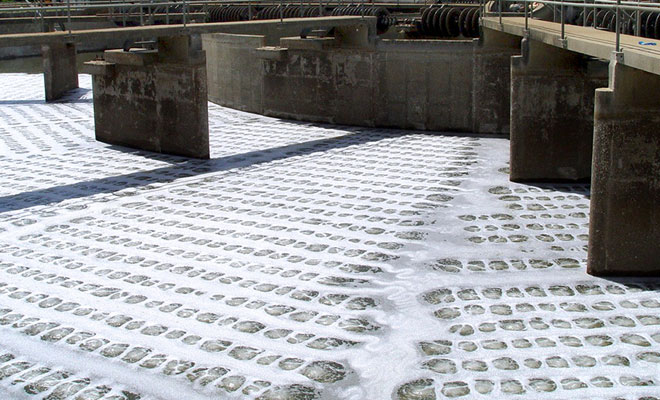
How do I account for high fluid velocity?
Modifying the support system to account for these forces is critical to long term system integrity.
High Fluid Velocity Causes and Considerations
When an aeration system is submerged and operating it is subject to a number of forces which cause the pipe to vibrate. Reducing this vibration, while at the same time allowing for expansion and contraction, is critical to the long term integrity of the system. A location in the tank where failures have commonly been seen is where obstructions or changes in flow path cause the fluid to have a high velocity.
Some often overlooked places in a tank that can result in high velocity are around:
• Baffle ports
• Wall notches and weirs
• Pipe discharge locations (RAS, MLR, etc.)
• Sluice/slide gates
• Connections between parallel tanks
• Points where a multiple pass tank wraps around the wall
• Pipe suction locations
• Sloped side walls or fillets greater than 5’x5’ (1.5m x 1.5m)
Consideration should be given for increasing the support system rigidity at locations where a high velocity is possible. Factors that affect the forces on the supports include:
• Distance from the structure causing the higher velocity
• Distributor/diffuser holder projected area exposed to the flow
• Fluid velocity
• Distributor centerline distance above the tank floor
Compensating for High Fluid Velocity
A number of design modifications to the standard support system are available to compensate for these high velocity areas including:
• Increasing the support rod thickness
• Adding struts to the header and manifold supports
• Decreasing support rod spacing
In general, the rule of thumb is that all of the supports within a minimum of a 10-foot radius OR half of the water depth, whichever is greater, should be modified to account for the high fluid velocity. If the fluid velocity is really high then additional supports may be needed or the supports can be modified by connecting them together using tie-bars, which will substantially increase the structural rigidity. If possible, calculations should be performed to define the actual velocity at the diffuser location and determine if support system modifications are required.

