Support System
-
What role does a support system play in aeration?
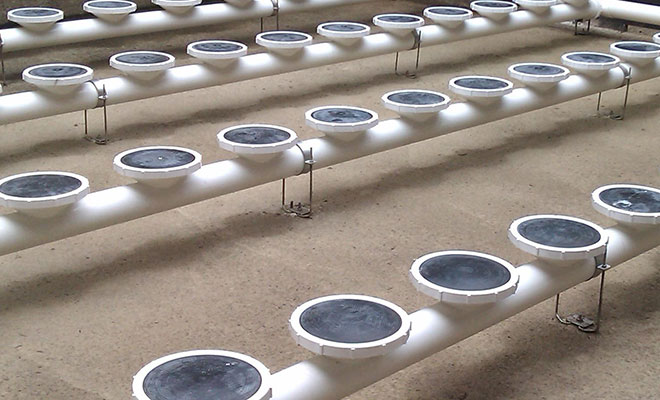
The support system is a critical part of any aeration system, holding the pipe to the floor of the tank allowing for expansion and contraction of the piping.
Importance of the Support System
In the same way that you should make sure that your tires are in good condition because they’re the only part of the vehicle that actually touch the road, it’s crucial to select the right supports and anchor bolts because they’re the only part of the aeration system that actually touch the tank floor. Often overlooked as small and relatively unimportant pieces of hardware, supports and anchor bolts are critical to the operation of the aeration system.
When observing an aeration system from the top of a tank, it appears that the purpose of the support system and anchor bolts is to hold the pipe up off of the floor. While that is the case when the tank is dry, once the tank is filled with water and the blower is turned on, the support system goes from holding the pipe up off of the floor to securing the pipe down on to it. In addition to the buoyancy of the pipe, the support system must also contend with numerous forces that may be present in a tank including:
• Forward flow in the tank
• Mixers
• Recycle pumps
• Baffle ports
• Influent pipes and gates
Additionally, if the plant is located in a seismically active region, the support system must also account for those factors as well. It is crucial that the aeration equipment manufacturer account for all of these factors in order to provide a comprehensive aeration system design.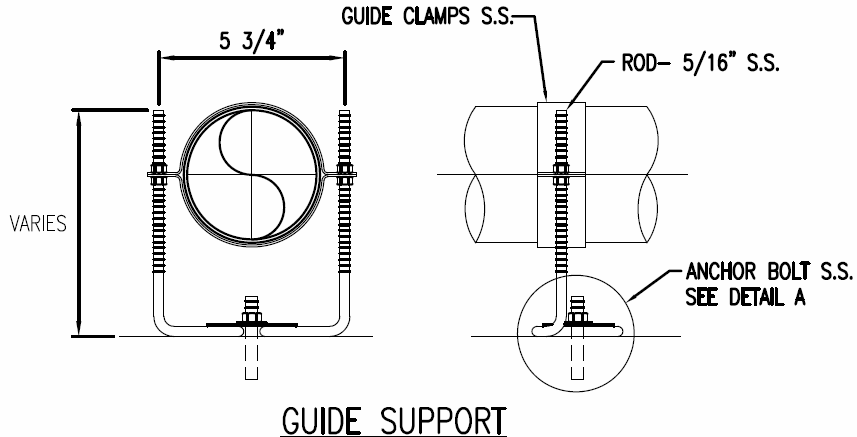
Purpose and Types of Supports
The supports serve two critical functions as part of the aeration system:
1. Holding the pipe to the floor of the tank
2. Allowing for expansion and contraction of the piping
Holding the pipe to the floor of the tank is necessary to counteract the buoyant force caused by air in the piping system. Allowing for expansion and contraction of the piping may not be as apparent, but is just as necessary. A wide range of temperatures is inflicted upon the aeration grid piping throughout the year. During operation the temperature of the water circulating around the pipe may fluctuate by only 10 to 20 degrees, however the blower air temperature varies directly with the fluctuating air temperature. This change in temperature causes the piping to expand and contract. The aeration system must accommodate this thermal expansion and contraction to prevent pipe from cracking and blowing apart. There are two ways to account for the expansion and contraction:
1. Guide supports
2. Expansion joints
Guide supports allow thermal expansion and contraction to occur in a controlled manner. The support clamps do not grip the pipe, but rather allow the piping to slide through the clamps – dissipating the expansion and contraction. Supports that grip the pipe are generally not recommended in an aeration system.
Expansion joints require anchor supports that grip the pipe during operation. The anchor support acts as a fixed point – forcing the expansion and contraction to occur out from that point. The pipe movement is then accounted for using an expansion joint. Typically, expansion joints represent a potential weak point in the aeration system due to the close tolerances required, so they are usually removed during the design process if possible.
Typically all supports in the aeration system are 304SS with 316SS as an option.
The thickness of the supports depends on the diameter of the pipe that it is holding. A distributor support is constructed from a single bent wire that is either 5/16” (8 mm) or 1/2" (12.7 mm) dia. Manifold supports are made up of either a single bent wire that is 1/2" (12.7 mm) dia (4”/110mm manifolds) or two individual rods that are 5/8” (15.9 mm) dia (> 4”/110mm manifolds).


Types of Anchor Bolts and their Advantages
Typically there are two types of anchor bolts that are used in aeration system designs:
1. Mechanical
2. Chemical
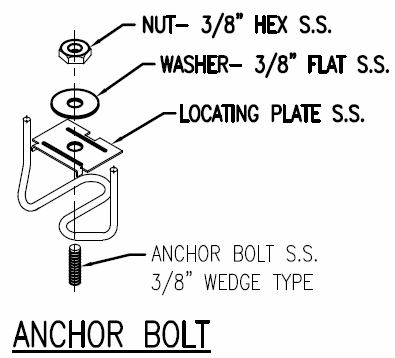
A type of mechanical anchor bolt used to secure the piping system is an expansion mechanical anchor. This type of anchor typically has a sleeve that goes over a cone at the bottom of the anchor bolt. As the bolt is installed in the hole that is drilled into the concrete floor, the sleeve expands over the cone and wedges itself against the concrete. Chemical anchors use an adhesive or epoxy to hold the anchor bolt into the hole in the concrete floor. Most aeration equipment manufacturers use the mechanical anchor bolt as their standard option. There are advantages to each type:
Mechanical
• Easier to install
• Less expensive
• No cure time / temperature concerns
Chemical
• Slightly stronger
• Offers protection against anchor bolt becoming corroded
Typically both types of anchor bolts are 304SS with 316SS as an option.
The size of the anchor bolt typically depends on the size of the pipe it is holding. Standard distributor support bolts are 3/8” dia (9.5 mm), while manifold support bolts are 1/2" (12.7 mm) or 5/8” (15.9 mm) dia depending on the manifold diameter.