

Fluid Velocity Mixers
-
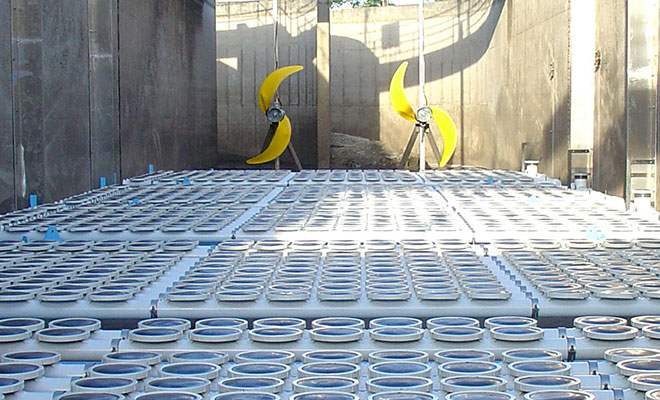
Calculating forces in a diffused aeration system.
Modifying the diffused aeration support system to account for forces caused by a mixer is critical to long term system integrity.
Operating Mixers and Aeration in the Same Zone
If you’ve ever stood in the ocean or a river and felt the force of the water moving past your body then you know how strong water can be. Similarly, when a mixer is placed in an area of the tank along with diffused aeration, the aeration equipment is subjected to the force of the moving water as well. Accounting for mixer forces is critical to long term system integrity.
The types of mixers that affect aeration systems include:
• High speed submersible mixers
• Mechanical aerators
• Low speed mixers
• Oxidation ditch motive force mixers
• Floating surface mixers
In general, the major concern with both mixers and aeration being located in the same zone is operating both pieces of equipment at the same time. Mixers can experience premature wear or damage when they’re operated in the presence of air bubbles in water; the bubbles can increase the load on the blades or force the shaft to become unbalanced. It is recommended that mixer manufacturers are consulted during the design process to determine if an area around the mixer should free of diffusers in order to protect the mixer.
Accounting for Mixer Forces in an Aeration System
Regarding the aeration manufacturers, as long as the location of the mixer and the fluid velocity are known, then the aeration support system can be modified to account for the increased forces and minimize any system integrity issues.
Consideration should be given for increasing the support system rigidity at locations where a high velocity is possible. Factors that affect the forces on the supports include:
• Distance from the mixer
• Type and diameter of the mixer
• Distributor/diffuser holder projected area exposed to the flow
• Fluid velocity
• Distributor centerline distance above the tank floor
Numerous design modifications to the standard support system are available where there is a high velocity, including:
• Increasing the support rod thickness
• Adding struts to the header and manifold supports
• Decreasing support rod spacing
• Adding dropleg sway brace
In general, the rule of thumb is that all of the supports within a minimum of a 15-foot radius OR one water depth, whichever is greater, should be modified to account for the high fluid velocity. If the fluid velocity is really high then additional supports may be needed or the supports can be modified by connecting them together using tie-bars, which will substantially increase the structural rigidity. If possible, calculations should be performed to identify the actual velocity at the diffuser location to determine if support system modifications are required.

