

Tapered Aeration Grid
-
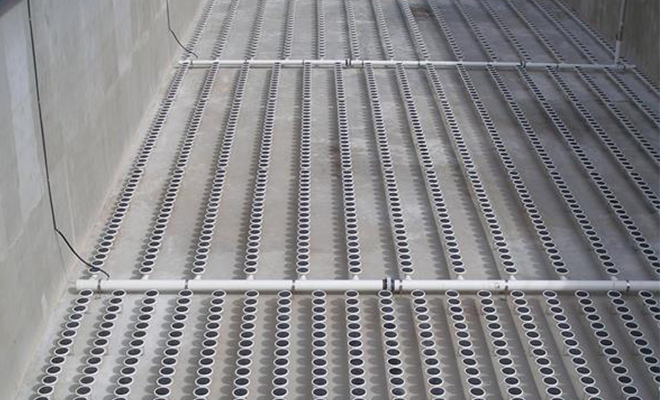
How do I design a tapered aeration system?
In a tapered aeration system, the distribution of aeration equipment is varied proportionally to the oxygen demand gradient.
Tapered Aeration Systems
When it comes to aeration systems, you want to deliver air where it’s needed. An oxygen demand taper occurs when there is a higher oxygen demand at the influent end of the tank than there is at the effluent end of the tank. In a tapered aeration system, the distribution of aeration equipment is varied proportionally to the oxygen demand gradient.
Typically, an oxygen demand gradient is exhibited in tanks that have plug flow conditions. Plug flow conditions are generally present in tanks that have a length to width ratio (L:W) of at least 3:1. For comparison, tanks with a L:W of 1:1 are classified as a complete mix reactor. For tanks between 3:1 and 1:1 an oxygen demand taper is not required, but may be used if the tanks are sufficiently long enough or if calculations show that plug flow-like conditions would be present.
Designing for an Oxygen Demand Taper
When a L:W ratio of greater than 3:1 is met, the most common approach is to divide the tank into roughly square zones. In a tank with a L:W of 3:1 that means three zones. In the absence of modeling, experience has shown that an oxygen distribution of 50% to the first zone, 30% to the second zone, and 20% to the third zone is a reasonable place to start. While this is a rough estimate, it has been used with a fair degree of accuracy in the past. As the geometry of the tank and number of zones changes, the oxygen distribution will change as well.
Additional factors to consider when designing a tapered layout include:
• Volumes of each zone
• Anoxic or anaerobic zones
• Incoming mixed liquor recycle or WAS lines
• Impacts of step feeding
• Future process needs
• Start-up conditions
• Peaking events
• Seasonal variations in temperature and load
It is important to note that a 50/30/20 oxygen distribution will not result in a 50/30/20 air distribution. This is due to the affect that diffuser density and diffuser air rate have on oxygen transfer efficiency (OTE). Additionally, the diffuser count may not end up being exactly a 50/30/20 split either due to the tank/zone geometry and the result of the differences in zone OTE.
When engineering a tapered grid design, the manufacturer’s challenge is evening out the top of dropleg pressures across all of the grids considering the differences in diffuser air rates, different headloss through each grid’s piping, and variations in conditions that may move more oxygen demand to one zone or another. In general, the goal is to have all of the grids operating as closely as possible to the same pressure at the average design condition. Ideally, the maximum deviation in top of dropleg pressure would be no greater than 0.1 psi (0.7 kPa) for all conditions; however, occasionally the requested design conditions require operating outside of this ideal case. As a result, throttling of the butterfly valve at the top of the tank, or changes in the oxygen delivered may be required on a temporary basis. A good tapered aeration design minimizes the need for valve throttling, which is both ineffective and a heavy burden on plant staff.

