

In 2018, the City of Polson contracted with DOWL to design a new water resource recovery facility, replacing the city’s lagoon-based treatment system that had been constructed in the 1950s. The new facility was designed to serve a population of approximately 5,500 with future expansion potential to serve more than 9,000. The new design included treatment processes that result in total nitrogen effluent limits of 8 mg/l and total phosphorus of 0.8 mg/l. DOWL evaluated numerous treatment solutions and selected a sequencing batch reactor process to provide nitrogen and phosphorus removal.
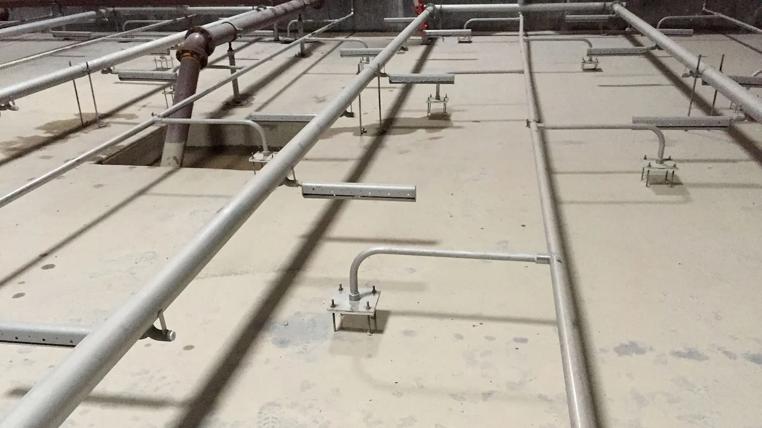
BioMix Compressed Gas Mixing nozzle headers integrate with coarse bubble aeration system.
0,15
HP/1,000 FT3 mixing efficiency
50
% energy savings
Challenge
A conventional aerobic sludge digestion process that uses diffused aeration for mixing often results in over aeration, which can cause uncontrolled nitrification, depletion of alkalinity, and increased energy consumption.
Solution
EnviroMix’s BioCycle-D™ Aerobic Digestion Process was selected to treat the sequencing batch reactors (SBR) waste sludge. BioCycle-D is an energy efficient aerobic sludge digestion process which decouples aeration from mixing and incorporates process feedback through instrumentation to control and maintain the optimum digestion environment.
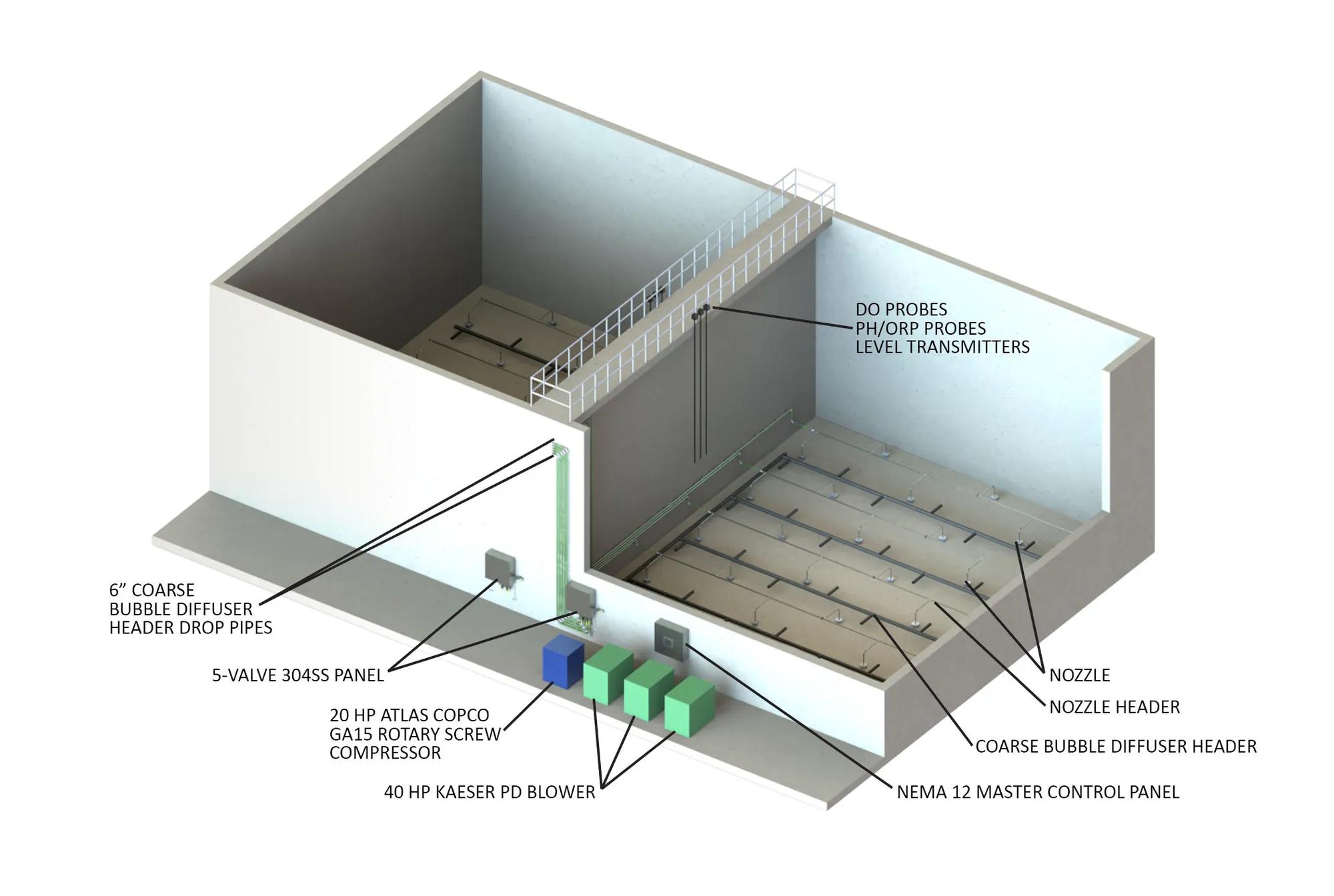
Polson’s digester configuration
So how does it work?
- During the BioCycle-D aerobic cycle, aeration blowers operate to maintain a user-selected DO concentration.
- The BioMix Compressed Gas Mixing System operates automatically as required during any portion of the operating cycle to provide adequate tank mixing.
- During the anoxic cycle, aeration blowers are disabled, and all mixing functionality is provided by the BioMix system.
- During the decant cycle, all aeration and mixing activity stops, sludge settles, and supernatant is returned to the head of the plant for improved secondary treatment performance.
Results
BioCycle-D is designed to be expandable and provide low-cost operation, and it plays an important part in keeping Polson’s user fees low. Selection criteria for the BioCycle-D process included both energy efficiency — which was approximately 50% of the energy of a conventional aerated digester alternative — and improved sludge digestion process control to minimize phosphorus return in the digester supernatant.