

Mixing limited conditions: A big problem with a simple solution
In aerobic process tanks, aeration equipment is conventionally designed to both deliver oxygen for biological treatment (process oxygen demand) and mix the contents of the basin. When the air demand required for treatment is LESS than that required for mixing, the process is considered mixing limited. Under mixing limited conditions, solids start to settle, reducing treatment efficiency and resulting in high energy consumption.
Keeping mixing airflow above the limit to satisfy oxygen demand results in excess aeration and high DO in the return streams, impacting effluent quality, chemical consumption, and settling.
Limiting airflow to satisfy the oxygen demand and DO setpoint while not maintaining optimal mixing can lead to MLSS stratification and deposition, as well as diffuser fouling.
What causes mixing limited conditions?
- Mixing limited conditions can be created by:
- Underloading compared to influent design conditions.
- Daily or seasonal influent load fluctuations.
- Hydraulic limitations that prevent taking trains out of service.
- Oxygen demand that is diminished by upstream aerobic zones.
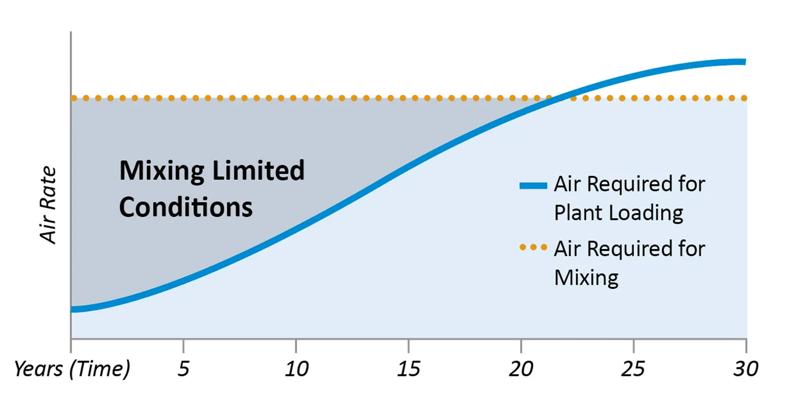 For a 30-year plant design, an aeration system may be mixing limited for 20+ years.
How does excessive aeration impact a treatment plant?
Excessive aeration impacts a treatment plant via:
- High dissolved oxygen (DO) concentrations in mixing limited zones
- Residual DO in return activated sludge (RAS) and mixed liquor return streams that inhibit biological nutrient removal (BNR).
- Poor settling.
- Excess chemical addition in post-anoxic zones.
- Wasted energy.
Solution: Compressed gas mixing
One way to successfully separate oxygen demand from mixing requirements is by decoupling aeration from mixing — i.e. the function of mixing is no longer provided by the diffused aeration system, typically allowing for smaller horsepower blowers, a smaller aeration system, and significant turndown capability. By interlacing compressed gas mixing equipment with aeration equipment in a complementary design, a “right-sized” diffused aeration and blower system provides air to satisfy process oxygen demand, while an energy efficient mixing system prevents solids from settling. This approach allows for independent control over oxygen delivery and mixing, preventing over-aeration and providing operational flexibility and energy savings.
When a compressed gas mixing system is interlaced with diffused aeration grids to provide mixing, this results in:
- Stable dissolved oxygen (DO) profile throughout the aeration tank.
- Protection of anoxic and anaerobic selectors to enable BNR.
- Conditions that promote good settling.
- Reduction or elimination of chemical addition in post-anoxic zones.
- Significant energy savings.
EnviroMix’s BioMix™ compressed gas mixing system provides uniform mixing of tank contents by firing programmed, short-duration bursts of compressed air through patented, engineered nozzles located near the tank floor. BioMix utilizes adjustable firing parameters (pressure, sequence, duration, and frequency) that enable ideal mixed conditions without deposition. The system provides complete mixing with proven negligible oxygen transfer. Ideal for mixing limited applications, BioMix easily integrates with aeration equipment and can operate concurrent with or independent from aeration, delivering BNR process control benefits and significant energy savings.
EnviroMix’s FlexZone® adaptive process volume system is a patented, versatile secondary treatment solution that advances the conventional approach to aeration and process design by integrating BioMix Compressed Gas Mixing, diffused aeration, instrumentation, and proprietary control algorithms to ensure precise aeration control and meet treatment objectives. The FlexZone dynamically adapts anoxic, low dissolved oxygen (DO), and aerobic environments to changes in loading and temperature while optimizing the bioreactor for nutrient removal, carbon management, and energy efficiency.