

When a leading Texas-based satellite manufacturer planned its new 700,000 sq. ft. production facility, it faced an unexpected hurdle: no access to municipal sewer infrastructure. Unlike traditional plants that rely on city systems for wastewater discharge, this site had no such option—meaning the team needed an alternative solution to keep production on schedule.

66
million gallons of water recovered
30
Million dollars + cost savings
Challenge
For a facility dedicated to producing next-generation communication satellites, uninterrupted operations were non-negotiable—any downtime could mean millions in lost revenue. One critical process, powder coating, requires large volumes of rinse water for pretreatment. But with no municipal sewer connection, the manufacturer faced a costly dilemma: hauling wastewater off-site at roughly $500 per 1,000 gallons. At a usage rate of 140 gallons per minute—nearly 70 million gallons annually—that approach was financially unsustainable.
To avoid mounting disposal costs, the manufacturer needed a zero liquid discharge (ZLD) system capable of recycling rinse water from its powder-coating pretreatment process while ensuring consistent uptime for mission-critical satellite production.
Solution
The manufacturer turned to Xylem to design and implement a custom-built water recycling and ZLD system that could meet the facility’s operational, financial, and sustainability goals.
Xylem provided a wastewater reuse system that incorporated multiple stages of treatment—reaction tanks, clarification, media filtration, activated carbon, ion exchange, reverse osmosis (RO), and electrodeionization (EDI)—to continuously refine rinse water from the production process waste.
This allows the facility to reuse virtually 95% of its water, with only a small concentrate stream requiring evaporation or off-site removal.
Given the highly automated nature of the factory, a digital-first approach was critical. At uniquely challenging points of use throughout the powder coating process, a closed loop recycle system reclaims the water for reuse, using the Water One® WX, wastewater ion exchange system. Xylem’s polishing system adds a 24/7, remotely monitored wastewater ion exchange layer that tracks rinsewater water quality in real time, flags anomalies (like rising filter pressure), and optimizes predictive maintenance to prevent downtime and lower costs. By servicing components only as needed, the line now runs with ~40% fewer operators (10+ to 6), aligning with the plant’s broader automation strategy.
Unlike piecemeal alternatives, Xylem was able to manufacture and deliver all equipment in-house—from treatment technologies to monitoring platforms—ensuring seamless integration and long-term reliability. The customer also benefits from single-source maintenance, warranty, and support, thereby reducing complexity and risk.
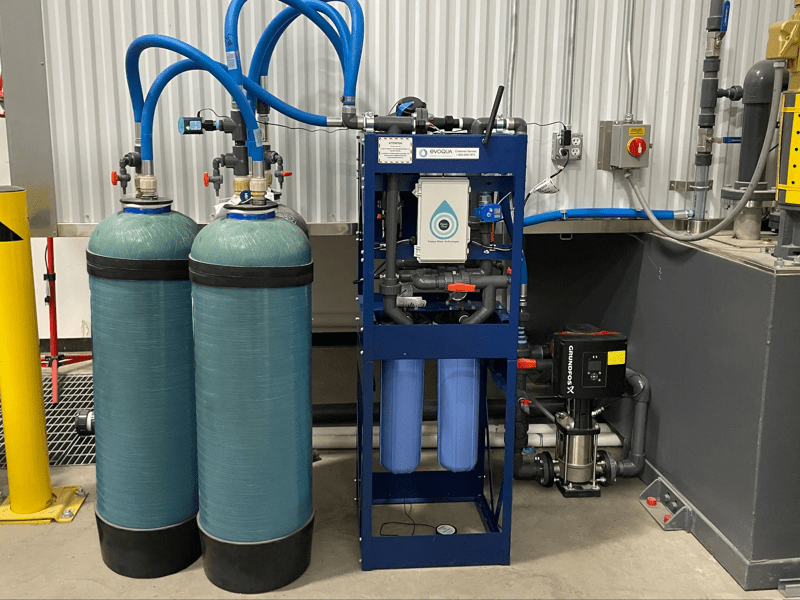
Xylem provides an advanced monitoring, control, and communications panel that is connected to the wastewater ion exchange system. Tank performance is monitored 24/7 with Xylem’s Link2Site® remote monitoring technology, which sends alerts for leaks, tank effluent quality, flow restrictions, and tank exchanges.
Results
The impact of Xylem’s digitally monitored wastewater treatment system has been immediate and measurable. The results have been transformative for the aerospace manufacturer:
- Water Reuse at scale: Out of 70 million gallons of water consumed annually, more than 66 million gallons are recovered and reused, significantly reducing the facility’s reliance on freshwater sources.
- Cost avoidance: By eliminating the need to haul wastewater at $500 per 1000-gallons, the manufacturer avoids tens of millions of dollars in annual disposal costs.
- Operational continuity: With predictive analytics and proactive monitoring, the system minimizes downtime risk — protecting satellite production operations from costly interruptions.
- Sustainability gains: Metals, TDS, and salinity are contained within the ZLD system, with no discharge back into the environment. This supports the manufacturer’s broader environmental goals while demonstrating leadership in sustainable aerospace manufacturing.
Digital monitoring has significantly enhanced water recovery and process efficiency by monitoring water quality and providing predictive insights that detect issues like filter obstructions and premature tank exhaustion. These insights enable upstream process improvements, such as optimizing powder-coating applications to reduce residual solids, which in turn lowers chemical usage, minimizes waste, and boosts production efficiency. This proactive approach empowers operations teams to prevent disruptions and maintain continuous production, demonstrating that smart water management is not just about compliance—it’s a key driver of industrial performance, cost savings, and sustainable growth.